

The Centuries-Old Cacao of Huila
Read a story from Katya’s diary of the ancient cacao from Huila, where native hybrid varieties grow side by side in diverse forest groves. After an ecological disaster nearly wiped all these out, local farmers took it into their own hands to preserve this unique cacao heritage.

On our last trip to Colombia, I was fortunate enough to meet David, the chocolate maker behind Provinzzia Cacao in Popayán, who introduced us to some of the best cacao varieties in the country. He was especially enthusiastic about the cacao from Huila and encouraged us to start our exploration there.
"It’s an amazing story of cacao preservation! This cacao grows not far from the Ecuadorian Amazon, one of the key places where cacao originated. We believe some ancient varieties are still preserved in these groves."
It wasn’t quite the forest conservation story we had found in Bolivia with wild Beniano cacao, but it was just as compelling — saving centuries-old native varieties that are endangered and still largely uninvestigated. David insisted we meet his friend, the farmer who produces this cacao. “He’s nicknamed Gordo (‘Fat’). You’ll see why. He’s just very big.” At first I thought the nickname a little harsh, until I arrived and realised he embraced it wholeheartedly, even calling his partner “Gorda.”

After a memorable and perilous route via La Plata, which turned out to be frequented by guerrillas, I happily arrived in a small town called Gigante. Gordo’s work partner had set off to fetch me on a motorbike, but when she didn’t appear, I hopped onto a passing bus. When I finally arrived, Gordo just laughed: Gorda, he teased, had been too slow because she carried “too much weight.” Gorda just burst out in goodnatured laughter without a slightest shade of embarrassment.


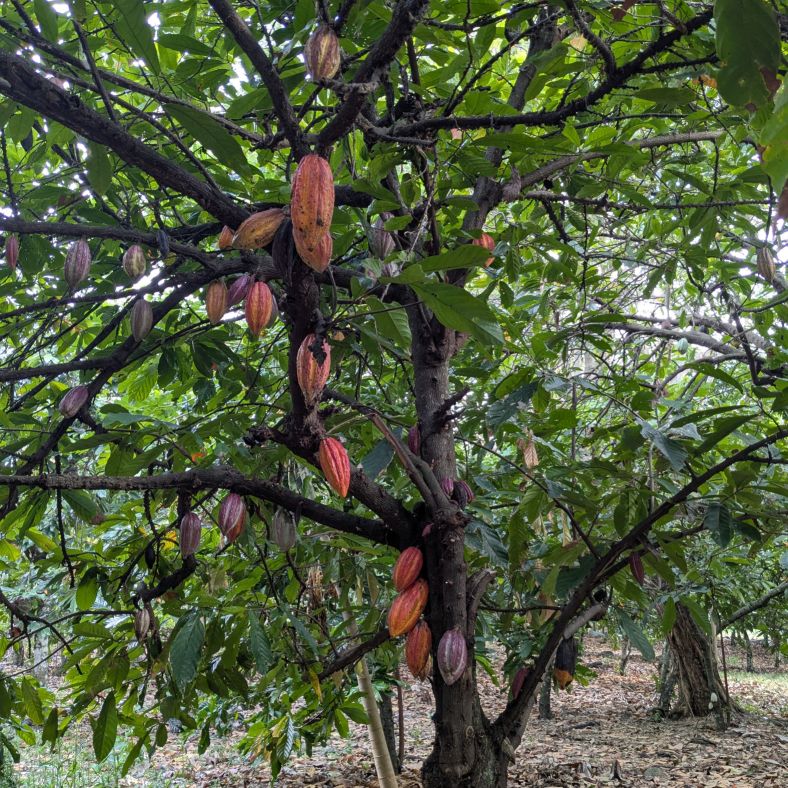
As soon as I arrived, we went straight to the cacao farms. The fincas were stunning examples of regenerative and organic farming, with pods in every shade: yellow, orange, pink, bright red, and dark red. “These trees are more than a hundred years old,” Gordo told me. Their bark was gnarled and furrowed, like something out of Tolkien’s Fangorn Forest.
We walked beneath their shade as Gordo, or Carlos, as is his real name, stopped at tree after tree, explaining everything from their history to grafting techniques to his long-term dream of reviving these forest-farms. He never really stops talking, but it’s infectious. Within hours, I was in love with these native hybrids too, and already wanted to help him protect them.
These living fragments of Colombia’s ancient cacao heritage nearly vanished when a dam project cleared most of the valley forests. A local farmer had tears in her eyes as she told me about the disaster. But some trees remained, and seeds were saved, replanted, and cared for. Thanks to the farmers’ stubborn determination, this heritage survives, fragile, but still alive.
We stopped by one of the old trees marked with a ribbon. “This one was selected by the scientists. It’s over a hundred years old.” About twenty different trees from various farms were selected for scientific investigation. I asked if they had shared the genetic results. Carlos only shrugged: “No, they just took the samples and left.”

The challenge?
Despite their rarity, farmers are often forced to sell this cacao at the same price as commercial clones. The companies that buy from these farmers are interested in uniformity and standardisation, not fine flavour or history. Thus, they encourage planting clones to increase productivity and lower the price. Many farmers planted these clones right next to the ancient trees, and over time cross-pollination threatens to erase the unique genetics. Some of these ancient cacaos could disappear before anyone even discovers what they truly are.
Farmers like Carlos are fighting against the tide, and look for people like us who appreciate the true value of fine cacao. He dreams of better prices, proper recognition, and dignified lives for the farmers. “I keep telling my colleagues: we need to work together, improve fermentation, make our own chocolate. Ten years ago we said this. Nothing changed. We need training, a bigger facility, investment. Otherwise we’ll always be stuck.”
Carlos is working alone on his dream project and he has a big job ahead of him. Not only is he leading the fermentation process but he is also working to maintain his two cacao farms, which have now turned into wild jungles.


One of the most memorable farms was Finca La Vuelta, hidden among sweeping grassy hills. Here, these old varieties are growing under shade of other endemic trees, some of them really tall. This farm was kept by the owner more as a passion project, as his main source of profit comes from sustainable livestock farming.
All the fincas are true conservation hubs, alive with biodiversity. Most sit near rivers, where groves of trees thrive along the banks - the key species is guadua bamboo, storing water and protecting the soil.
Supporting farmers like Carlos means more than saving rare cacao. We are preserving unique natural and cultural heritage, while also creating resilient landscapes that can withstand the pressures of climate change. Carlos’ story needs to be heard, and there’s an urgent need to change the current model, which is still built on unsustainable industry practices.

